Why Retail Trade Promotion Systems Don’t Work for Foodservice Businesses?

Many consumer products manufacturers operate across two routes to market: retail and foodservice. At first glance, it may seem practical to manage both inside one system. In reality, the commercial models behind these channels are structured very differently.
When a system is built around retail trade promotion logic, friction appears once foodservice volume begins to grow.
Table of Contents:
- Two Routes to Market, Two Commercial Structures
- Where Retail TPM Systems Begin to Strain?
- The Operational Risk of Forcing One Model Into Another
Jump to a section that interests you, or keep reading.
Two Routes to Market, Two Commercial Structures
Retail
Retail involves selling products through direct or indirect distribution into physical stores or ecommerce outlets, where consumers purchase items for later consumption.
Retail trade planning focuses on:
- Point-of-sale (POS) promotions
- Merchandising conditions
- Deductions
- POS deals
- Annual budgets with fixed funding, variable rates, or both
Retail systems are typically built around product and customer hierarchies. Promotions can be planned at multiple levels, which reduces repetitive data entry and allows account managers to manage overlapping short-term activities across many customer plans.
The structure is hierarchy-driven, and reporting is often performed across those hierarchical levels.
Foodservice / B2B
Foodservice products are sold through an indirect distribution network with the expectation of immediate consumption.
This route to market operates differently:
- Contract pricing instead of POS promotions
- Rebate programs
- Deviated pricing
- Claims processing
- Sales incentive administration
- Bid management
- Volume management across a three-tier supply chain
Planning is typically minimal compared to retail. The focus is on managing contracts at the lowest level of customer-product hierarchies — usually at the SKU level.
Unlike retail, programs are not built around promoted pricing groups or higher-level hierarchies. Contracts and programs are created and managed per SKU.
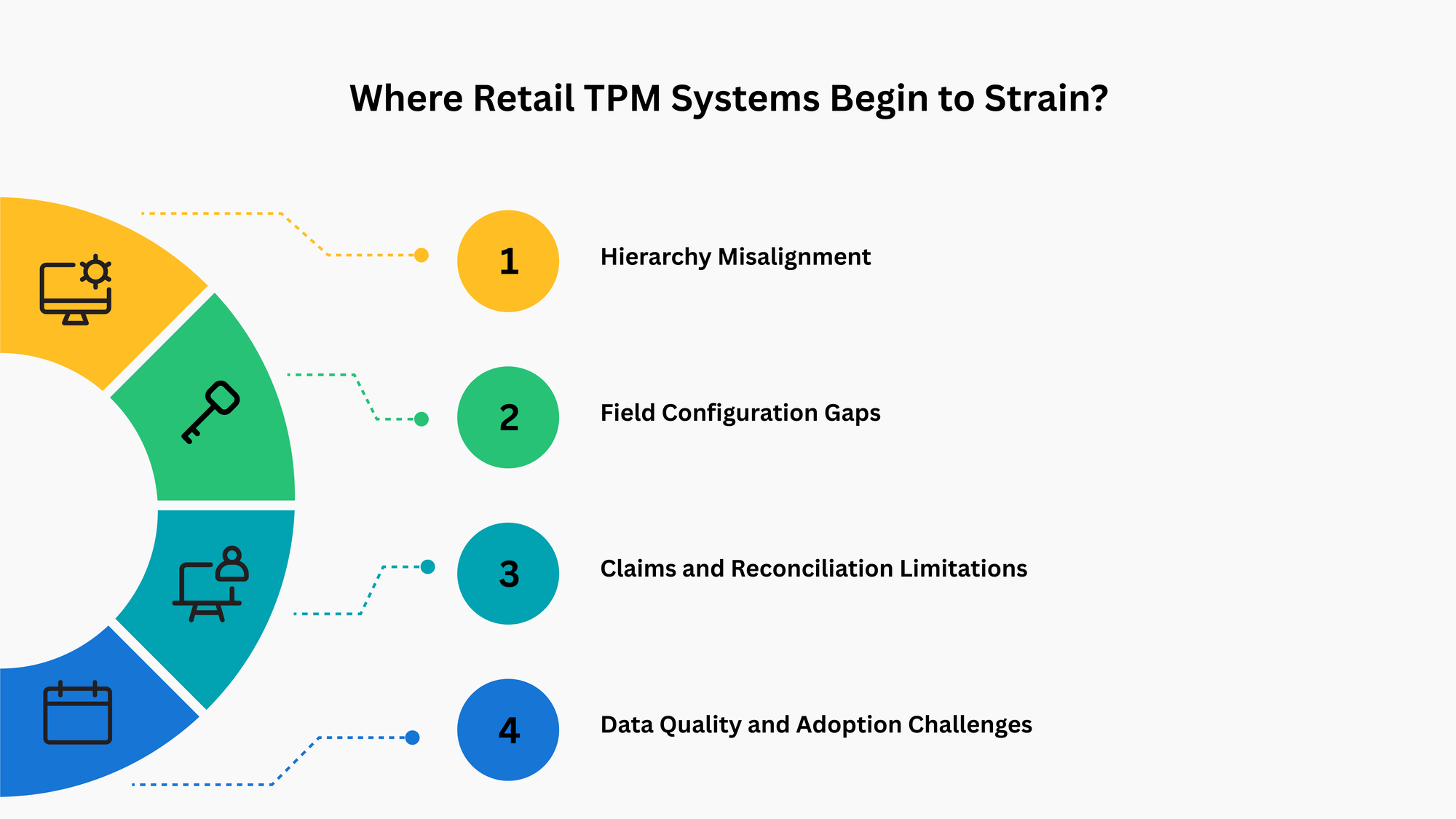
Where Retail TPM Systems Begin to Strain?
Retail trade promotion systems are designed around retail processes and KPIs. When a manufacturer attempts to manage foodservice inside that same structure, several issues emerge.
1. Hierarchy Misalignment
Retail systems rely heavily on hierarchical planning. However, foodservice contracts are created at the SKU level. This removes much of the hierarchy advantage and increases manual entry.
In large environments — such as 60 to 70 customer plans and 2,500 to 3,000 SKUs — backend allocation becomes complex. Retail applications often store data at the lowest level for reporting purposes, which increases database strain as the business grows.
2. Field Configuration Gaps
Retail configurations may require base and lift forecasting entries. That structure aligns with promotional planning but does not naturally align with contract-based foodservice selling.
Field descriptions and input logic differ between the two models, making data entry more complicated when the system is configured for retail.
3. Claims and Reconciliation Limitations
Foodservice relies heavily on claims validation and reconciliation from accrual to settlement.
Retail-focused systems may not provide:
- Claims validation capability
- Reconciliation traceability
- Clear linkage between accruals and settlement
Without these, tracking financial accuracy becomes difficult.
4. Data Quality and Adoption Challenges
When systems do not reflect how the business actually operates:
- Data entry becomes increasingly complex
- Reporting quality declines
- Account managers become frustrated
- Brokers resist working in the system
As a result, processes often move back to spreadsheets.
The Operational Risk of Forcing One Model Into Another
Some manufacturers begin with a strong presence in one route to market and a smaller presence in the other. Over time, growth or acquisitions can shift the balance.
If a manufacturer with a retail-configured system grows its foodservice business to equal size, offline spreadsheet management becomes difficult to sustain. Automation becomes necessary — but automation built around retail logic may not match foodservice requirements.
Even when providers claim their application can manage both channels, the key question is how the system is configured and who is actively using it across both routes to market.
The issue is not simply whether a system can technically handle both. It is whether the underlying structure aligns with:
- Hierarchy-driven retail promotion management
- SKU-level contract-driven foodservice management
These are fundamentally different operational models.
Final Takeaway
Retail trade promotion systems are designed around POS activity, hierarchical planning, and promotional funding structures.
Foodservice businesses operate around contracts, rebates, claims, and SKU-level program management within a three-tier supply chain.
When a retail-configured system is used to manage foodservice operations, misalignment appears in data entry, reporting, reconciliation, and user adoption.
The challenge is not about running both channels in one place. It is about ensuring the system structure matches the commercial reality of each route to market.