How to Optimize Pharma Rebates & Chargebacks?

The U.S. pharmaceutical industry continues to dominate global revenue, accounting for nearly half of worldwide pharma sales. Yet behind this scale sits a dense system of pricing arrangements, regulatory demands, and financial adjustments. Among the most influential elements in this system are rebates and chargebacks—two mechanisms that directly shape profitability, access, and compliance.
As regulation tightens, payer behavior shifts, and operational pressure grows, optimizing how rebates and chargebacks are managed has become a business requirement rather than an operational afterthought.
Table of Contents:
- Why Rebates and Chargebacks Matter More Than Ever?
- What are Rebates and Chargebacks in Pharma?
- Core Challenges in the Current Environment
- Trends Reshaping Rebate and Chargeback Management
- Practical Ways to Optimize Rebates and Chargebacks
- The Growing Role of AI in Optimization
Jump to a section that interests you, or keep reading.
Why Rebates and Chargebacks Matter More Than Ever?
Pharmaceutical innovation continues to progress through biologics, gene therapies, and personalized medicine. At the same time, pricing and reporting complexity is increasing.
Several forces are driving this shift:
- Regulatory oversight is increasing through transparency mandates and recent healthcare legislation
- PBM and payer consolidation is changing how discounts are negotiated and reported
- Manual workflows and spreadsheet-based processes continue to drain time and margins
Together, these pressures make rebate and chargeback management a central concern for finance, compliance, and leadership teams.
What are Rebates and Chargebacks in Pharma?
Rebates and chargebacks play different but connected roles in pharmaceutical pricing.
Rebates are retrospective discounts paid by manufacturers to payers such as PBMs, insurers, or Medicaid programs. They are tied to negotiated contracts and influence formulary placement, volume commitments, and market access.
Chargebacks occur when wholesalers sell products at a contractually agreed price that is lower than their acquisition cost. Manufacturers then reimburse the wholesaler for the difference to maintain pricing compliance for hospitals, pharmacies, and group purchasing organizations.
Both mechanisms directly affect gross-to-net revenue and overall financial performance.
Core Challenges in the Current Environment
Even large pharmaceutical companies face ongoing operational strain when managing rebates and chargebacks. Common challenges include:
- Disconnected systems and spreadsheet-based workflows that create data silos
- Lengthy adjudication cycles that delay payments and trigger disputes
- Gaps in regulatory reporting that raise audit risk
- Limited visibility into rebate liabilities and chargeback claims
As legislation continues to shift, these issues compound rather than resolve on their own.
Trends Reshaping Rebate and Chargeback Management
Several industry-wide changes are redefining how rebate and chargeback operations function:
- Greater regulatory transparency is increasing net price disclosure requirements
- Near real-time processing is replacing quarterly or manual submissions
- AI and machine learning are being applied to adjudication, anomaly detection, and forecasting
- Cross-functional alignment between finance, sales, and contracting teams is improving visibility across the gross-to-net lifecycle
These developments are raising expectations for speed, accuracy, and control.
Practical Ways to Optimize Rebates and Chargebacks
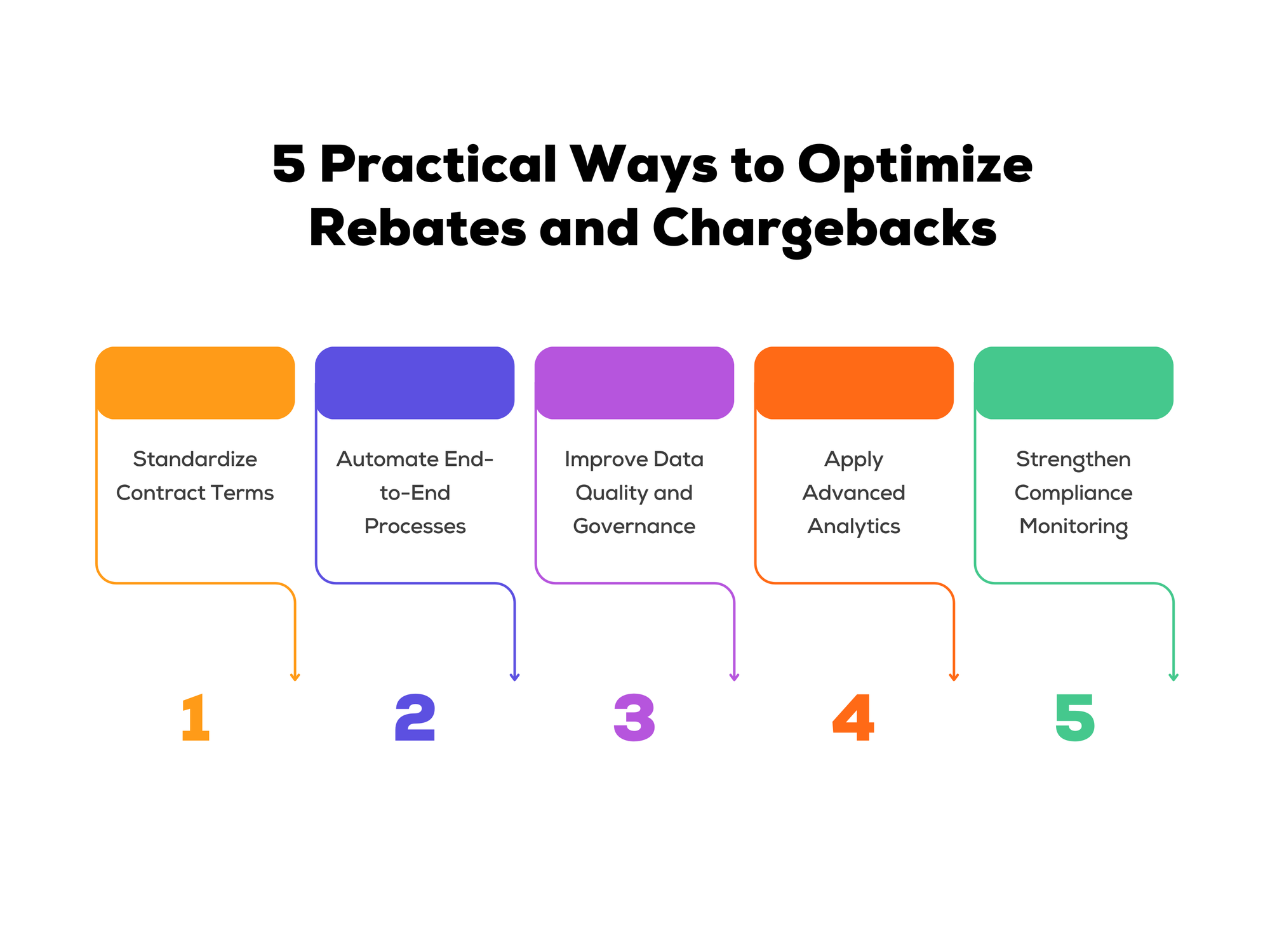
Leading pharmaceutical companies are improving rebate and chargeback management by focusing on five core practices:
1. Standardize Contract Terms
Centralizing and clarifying rebate and pricing agreements helps reduce disputes and interpretation gaps.
2. Automate End-to-End Processes
Automation across data intake, adjudication, and reconciliation reduces manual workload and processing delays.
3. Improve Data Quality and Governance
Maintaining accurate customer records and contract hierarchies supports more reliable gross-to-net reporting.
4. Apply Advanced Analytics
Predictive modeling helps forecast liabilities and supports better contract design decisions.
5. Strengthen Compliance Monitoring
Continuous auditing and exception tracking support alignment with evolving regulatory requirements.
Together, these steps support clearer visibility and more consistent financial outcomes.
The Growing Role of AI in Optimization
Artificial intelligence is increasingly shaping how rebate and chargeback operations are handled.
AI supports:
- Anomaly detection, identifying duplicate claims or pricing mismatches before they affect revenue
- Forecasting and GTN modeling, simulating pricing scenarios and rebate exposure
- Contract analysis, grouping customers and structuring incentives more precisely
- Natural language processing, extracting and monitoring key contract terms at scale
These capabilities allow faster decisions with reduced manual effort and improved oversight.
Conclusion
Rebates and chargebacks are no longer limited to administrative processing. They influence access, compliance, and financial performance across the pharmaceutical value chain.
By improving contract clarity, strengthening data foundations, adopting automation, and applying analytics, pharmaceutical companies can gain stronger visibility and control over rebate and chargeback activity—supporting sustainable operations in an increasingly complex environment.