How to Negotiate Your PBM Contract?

Negotiating a Pharmacy Benefit Manager (PBM) contract is one of the most important financial decisions a plan sponsor can make. PBMs control pricing, discounts, rebates, and classification rules that directly affect total drug spend. While PBM contracts may appear straightforward on the surface, subtle language choices can materially shift value away from the plan sponsor.
Based on experience negotiating billions of dollars in pharmaceutical spend across millions of covered lives, the following areas represent the most critical elements you must understand before finalizing a PBM agreement.
Table of Contents:
- Understand How Average Wholesale Price Is Defined
- Ensure Clear Brand and Generic Drug Classification
- Control Specialty Drug Definitions
- Scrutinize Rebate Language Carefully
- Define How Generics and MAC Pricing Are Treated
Jump to a section that interests you, or keep reading.
Understand How Average Wholesale Price Is Defined
Average Wholesale Price (AWP) is one of the most commonly used pricing indices in PBM contracts. However, AWP is not the pharmacy’s actual acquisition cost. On average, it is inflated by roughly 25% compared to what pharmacies pay wholesalers.
AWP is published at the NDC-11 level, which identifies a drug’s:
- Manufacturer
- Strength and dose form
- Package size
PBM contracts typically offer pricing as a discount off AWP, segmented by drug type and channel (retail, mail, generic, brand). The way AWP is defined in the contract is critical.
If the AWP definition is vague, a PBM may:
- Select the highest available AWP
- Use a different AWP date than the dispense date
- Substitute a similar NDC
- Repackage drugs into sizes with higher AWPs
Because performance guarantees are measured across drug buckets rather than individual prescriptions, these tactics can raise PBM margins without changing the actual cost paid by the plan.
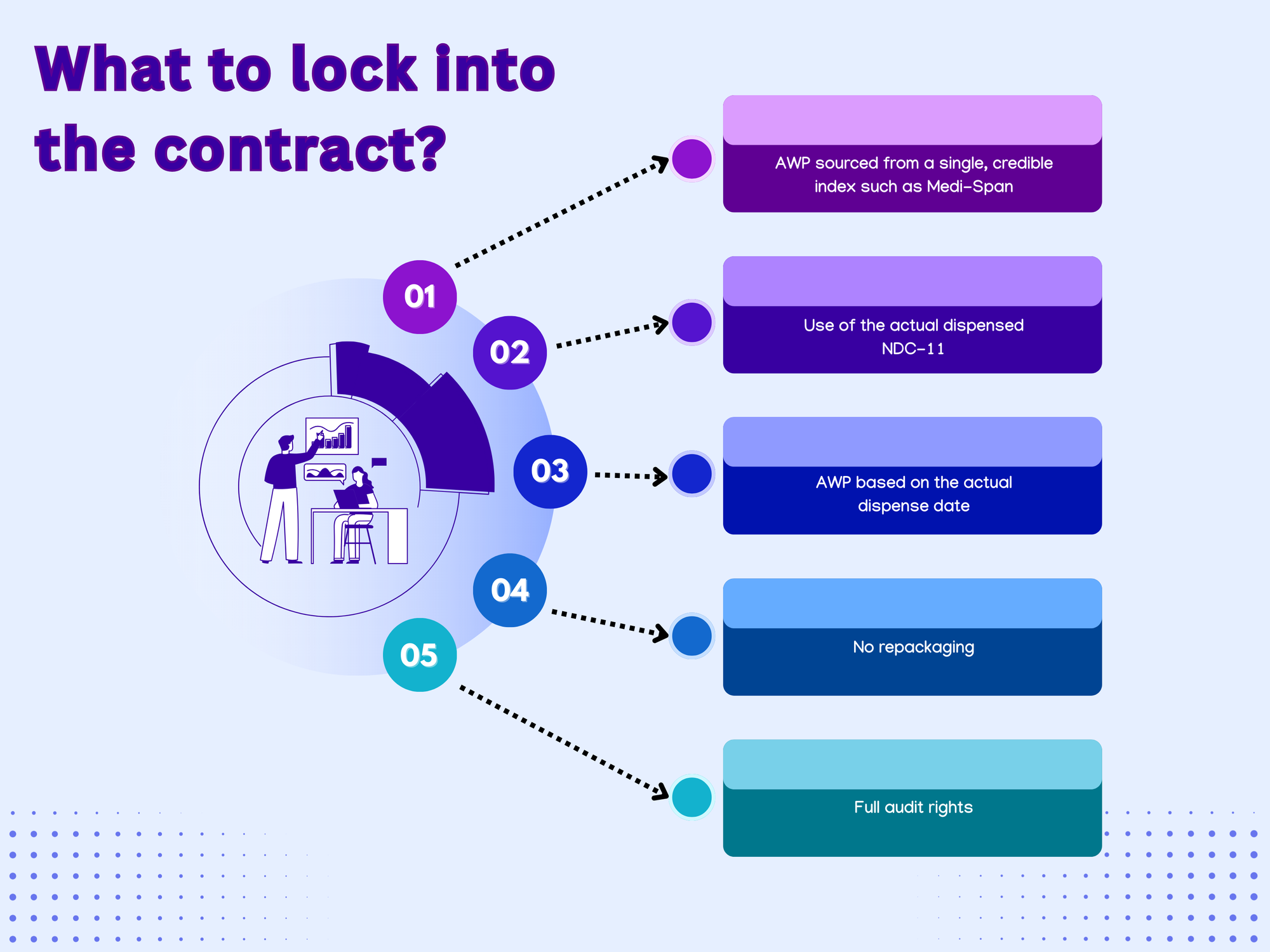
What to lock into the contract
- AWP sourced from a single, credible index such as Medi-Span
- Use of the actual dispensed NDC-11
- AWP based on the actual dispense date
- No repackaging
- Full audit rights
Poor AWP language can cost 1–3% of total ingredient cost.
Ensure Clear Brand and Generic Drug Classification
Drug classification has a major financial impact. While it may seem simple to distinguish brand from generic drugs, PBM contracts often exploit gray areas.
After patent expiration, drugs may enter a single-source generic period lasting roughly six months. These drugs are technically generic but priced like brands due to lack of competition. PBMs may classify these as brands instead of generics, allowing them to improve reported discounts without improving actual economics.
By shifting drugs between buckets, PBMs can:
- Inflate brand and generic discount percentages
- Retain value internally
- Present stronger headline guarantees
Key protections to negotiate
- Single-source generics classified as generics
- Generics in short supply included as generics
- Drugs under patent litigation included as generics
- House generics (DAW-5 claims) included
- Drugs treated as brands must still receive minimum rebates

Weak definitions here can cost 3–6% or more of non-specialty drug spend.
Control Specialty Drug Definitions
Specialty drugs represent the fastest-growing and often largest portion of total drug spend. Definitions vary widely and may be based on:
- Cost
- Distribution and handling requirements
- Drug type, such as biologics
Specialty drugs also receive significantly higher rebate guarantees than non-specialty drugs. A PBM contract may promise:
- $200 per brand non-specialty prescription
- $2,000 per brand specialty prescription
This makes classification especially important.
Specialty drugs may also be divided into subgroups, such as Limited Distribution Drugs (LDDs), which are dispensed by only a few pharmacies. PBMs may claim weaker pricing in these cases unless contract language prevents it.
Best practices
- Use a fixed NDC list to define specialty drugs
- Prevent unilateral changes by the PBM
- Treat LDDs the same as other specialty drugs when possible
- Require plan approval and notice before any reclassification
Poor specialty definitions can cost 20–30% or more of specialty drug spend.
Scrutinize Rebate Language Carefully
Rebate guarantees vary by channel and drug type, with specialty drugs typically generating the highest amounts. However, minimum rebates are only part of the picture.
PBMs may receive total manufacturer compensation that includes:
- Rebates
- Manufacturer administrative fees (up to 5% of drug cost)
- Price protection payments
- Data-sharing fees
- Other forms of compensation
Even when a PBM agrees to pass through 100% of rebates, that may represent only 70–80% of total manufacturer compensation.
What to require
-
Disclosure of all manufacturer compensation
-
Clear definition of rebate-eligible drugs
-
Explicit inclusion of:
- Non-formulary brand drugs
- Limited distribution drugs
- New-to-market drugs
- Biologics and biosimilars
- Drugs where manufacturers do not pay the PBM
Weak rebate language can cost up to 50% of total rebates.
Define How Generics and MAC Pricing Are Treated
Generic pricing may be based on:
- Discounted AWP
- Usual & Customary (cash price)
- Maximum Allowable Cost (MAC) pricing
PBMs often provide a Generic Effective Rate (GER) that blends MAC and non-MAC generics. If the MAC list is not clearly defined, PBMs can control:
- Which drugs are MAC’d
- MAC price levels
- Frequency of price changes
This flexibility allows PBMs to limit risk and increase margins, even affecting brand pricing indirectly.
Contract protections
- GER applies to all generics
- MAC list definition is explicit
- Clear rules on MAC price changes
- Advance notification requirements
- Audit access to MAC lists
Poor MAC language can cost 2–5% of non-specialty drug spend.
Conclusion
PBM contracts are complex by design, and small language choices can shift millions of dollars in value. AWP definitions, drug classification, specialty rules, rebate treatment, and MAC pricing must all be clearly defined and auditable.
The most important rule when negotiating a PBM contract is simple: question everything before you sign.