4 Core CPG Pricing Strategies for Foodservice

Pricing has never been easy for CPG manufacturers serving foodservice. Today, it is even more complicated. Persistent inflation, shifting trade policies, and supply chain instability are forcing companies to rethink how prices are set and adjusted.
The central question facing commercial and finance teams is straightforward:
Do you increase prices and risk losing customers, or absorb rising costs and accept shrinking margins?
Restaurants, schools, and hospitality operators are already under pressure. Suppliers must maintain supply relationships while protecting profitability. Pricing decisions now sit at the center of that balance.
Table of Contents:
- The Reality of Inflation and Tariffs
- Why Pricing Decisions Can’t Rely on the P&L Alone?
- Four Core CPG Pricing Strategies for Foodservice
- Choosing the Right Approach
- Key Considerations for Foodservice Pricing
- Managing Risk in Pricing Decisions
Jump to a section that interests you, or keep reading.
The Reality of Inflation and Tariffs
Inflation continues to reshape purchasing behavior across the foodservice environment. Between September 2024 and September 2025, the U.S. Consumer Price Index rose 2.9%. Food prices increased 3.2% during the same period, and overall food costs have climbed 26.61% since 2020, according to the Bureau of Labor Statistics.
For restaurants operating on margins as low as 3–5%, even small cost increases matter. Tariffs add another layer of pressure by raising input costs and creating uncertainty in sourcing and planning.
Some manufacturers attempt to absorb these increases temporarily, hoping conditions will stabilize. However, the financial impact compounds quickly.
Example scenario:
- Net income: 15% of revenue
- Cost of goods sold (COGS): 50% of revenue
- Inflation impact: 10% increase in COGS
On $1 million in monthly revenue, net income drops from $150,000 to $100,000 — a $50,000 monthly decline. Delaying pricing action in this situation steadily weakens financial performance.
Why Pricing Decisions Can’t Rely on the P&L Alone?
A profit-and-loss statement shows rising costs, but it does not always reflect the full picture. Inflation changes how inventory, replacement costs, and market conditions should be evaluated.
Key considerations include:
Inventory timing
Products manufactured months apart may carry very different costs. Treating inventory as uniform can lead to incorrect pricing decisions.
Replacement cost awareness
Inventory should be priced based on what it costs to replace today, not what it cost historically.
Market context
Customer demand, competitor moves, and brand positioning must influence pricing alongside internal cost data.
Pricing decisions that rely only on accounting outputs often miss these realities.
Four Core CPG Pricing Strategies for Foodservice
According to the National Restaurant Association, 84% of restaurant operators cite rising food costs as their biggest challenge in 2025. Suppliers must therefore choose pricing approaches carefully.
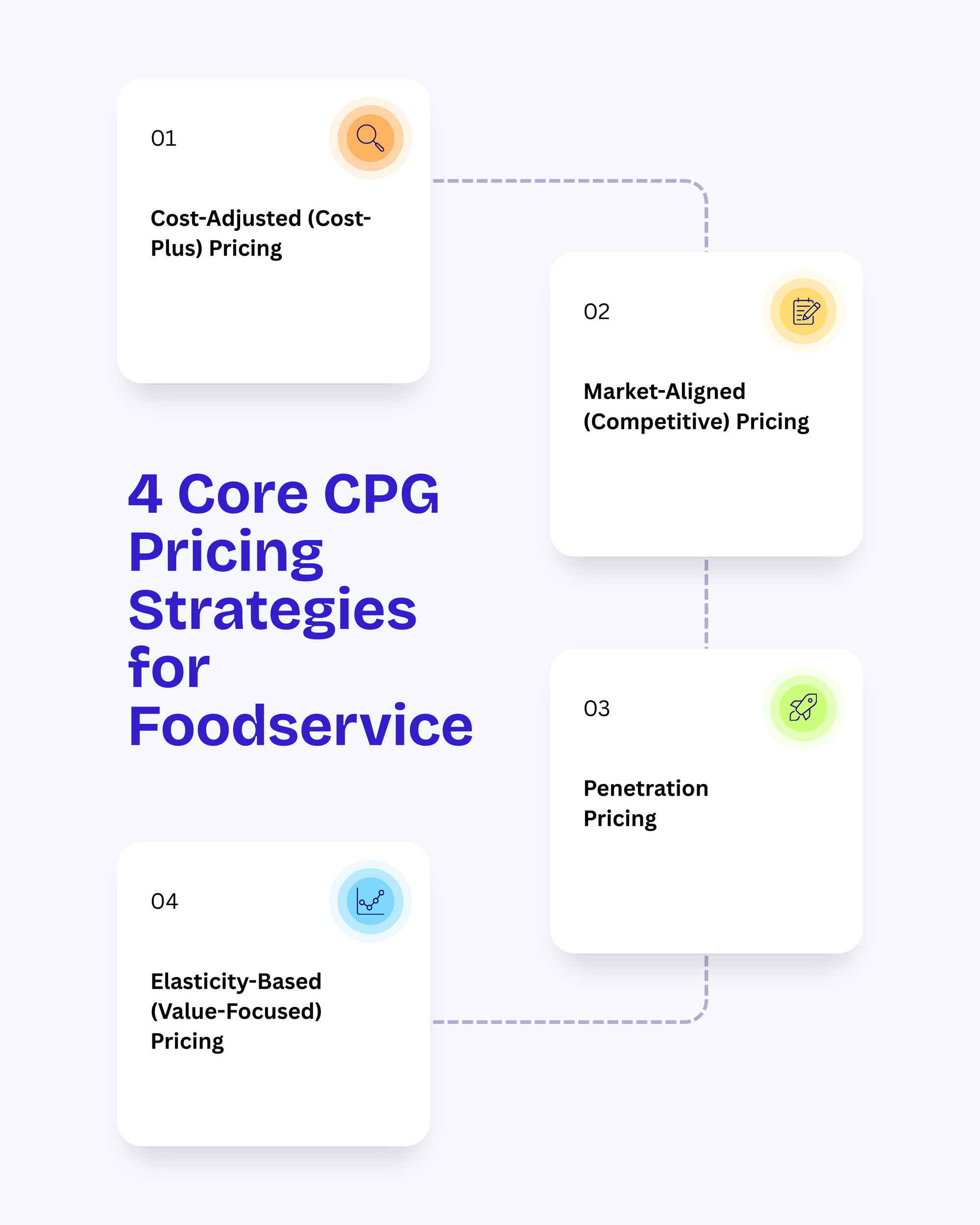
1. Cost-Adjusted (Cost-Plus) Pricing
Prices increase in proportion to cost increases.
Advantages
- Simple to implement
- Helps recover rising costs quickly
Limitations
- Ignores customer sensitivity and competitive positioning
- Cost increases do not always reflect perceived value
When it works
Useful for short-term stabilization, particularly for essential or differentiated products. It requires clear communication with customers to justify adjustments.
2. Market-Aligned (Competitive) Pricing
Prices are set relative to competitors’ benchmarks.
Advantages
- Maintains competitiveness in price-sensitive categories
- Reflects current market expectations
Limitations
- Difficult to track consistently during volatile periods
- Following competitors too closely can limit strategic flexibility
When it works
Best supported by consistent market monitoring and clear understanding of where differentiation exists.
3. Penetration Pricing
New products enter the market at lower introductory prices to encourage adoption.
Advantages
- Encourages trial and faster adoption
- Helps establish early distribution
Limitations
- Lower margins during early stages
- Risk of long-term price expectations remaining low
When it works
Requires a defined path toward sustainable pricing once adoption is achieved.
4. Elasticity-Based (Value-Focused) Pricing
Pricing decisions rely on demand sensitivity and data analysis to balance price and volume.
Advantages
- Improves margin management
- Aligns pricing with customer willingness to pay
Limitations
- Requires analytics capabilities and ongoing monitoring
- Still underused across the industry, with only about 25–30% of manufacturers applying advanced pricing analytics
When it works
Particularly valuable when customers face budget constraints and purchasing decisions become more selective.
Choosing the Right Approach
No single pricing model works in every situation. Most manufacturers combine approaches depending on product category, customer segment, and market conditions.
Short-term cost recovery may rely on cost-based pricing, while longer-term stability comes from aligning prices with customer value and market realities.
Companies that integrate multiple pricing methods supported by data are better positioned to maintain margins and customer relationships.
Key Considerations for Foodservice Pricing
Selecting a pricing model is only the starting point. Execution requires continuous evaluation across several factors:
- Data insights: Understand purchasing patterns and demand changes.
- Cost visibility: Examine cost drivers beyond tariffs alone.
- Brand positioning: Ensure pricing reflects product positioning.
- Tiered product structures: Offer different formats or pack sizes for varied budgets.
- Promotional flexibility: Use targeted discounts without weakening long-term pricing.
- Competitive monitoring: Track market changes consistently.
- Margin focus: Balance volume goals with profitability.
- Technology adoption: Use systems that support timely pricing adjustments.
Pricing today involves coordination across finance, sales, marketing, and operations rather than a single department decision.
Managing Risk in Pricing Decisions
To reduce exposure during uncertain conditions, manufacturers should:
- Define clear pricing objectives aligned with business priorities
- Conduct detailed cost analysis to identify pressure points
- Model price sensitivity by product and customer segment
- Build scenario plans for changing market conditions
- Use price-pack architecture to adjust value without broad price increases
Offering multiple pack sizes, bundles, or formats allows companies to respond to customer constraints while protecting margins.
Final Thoughts
Inflation, tariffs, and market volatility have changed how pricing decisions must be approached in foodservice. Reactive price increases are no longer sufficient. Pricing now requires ongoing evaluation of costs, customer expectations, and competitive dynamics.
Manufacturers that treat pricing as a continuous business discipline — supported by data, collaboration, and planning — are better positioned to protect profitability while maintaining strong partnerships across the foodservice supply chain.