Best Practices for Revenue Recognition in Pharmaceutical Accounting


Revenue recognition is a critical component of financial reporting in the pharmaceutical industry. The mix of licensing deals, supply arrangements, milestone payments, and services creates a landscape where timing and valuation must be handled with precision. Because of this complexity, companies rely on the principles of ASC 606, the standard governing revenue from contracts with customers.
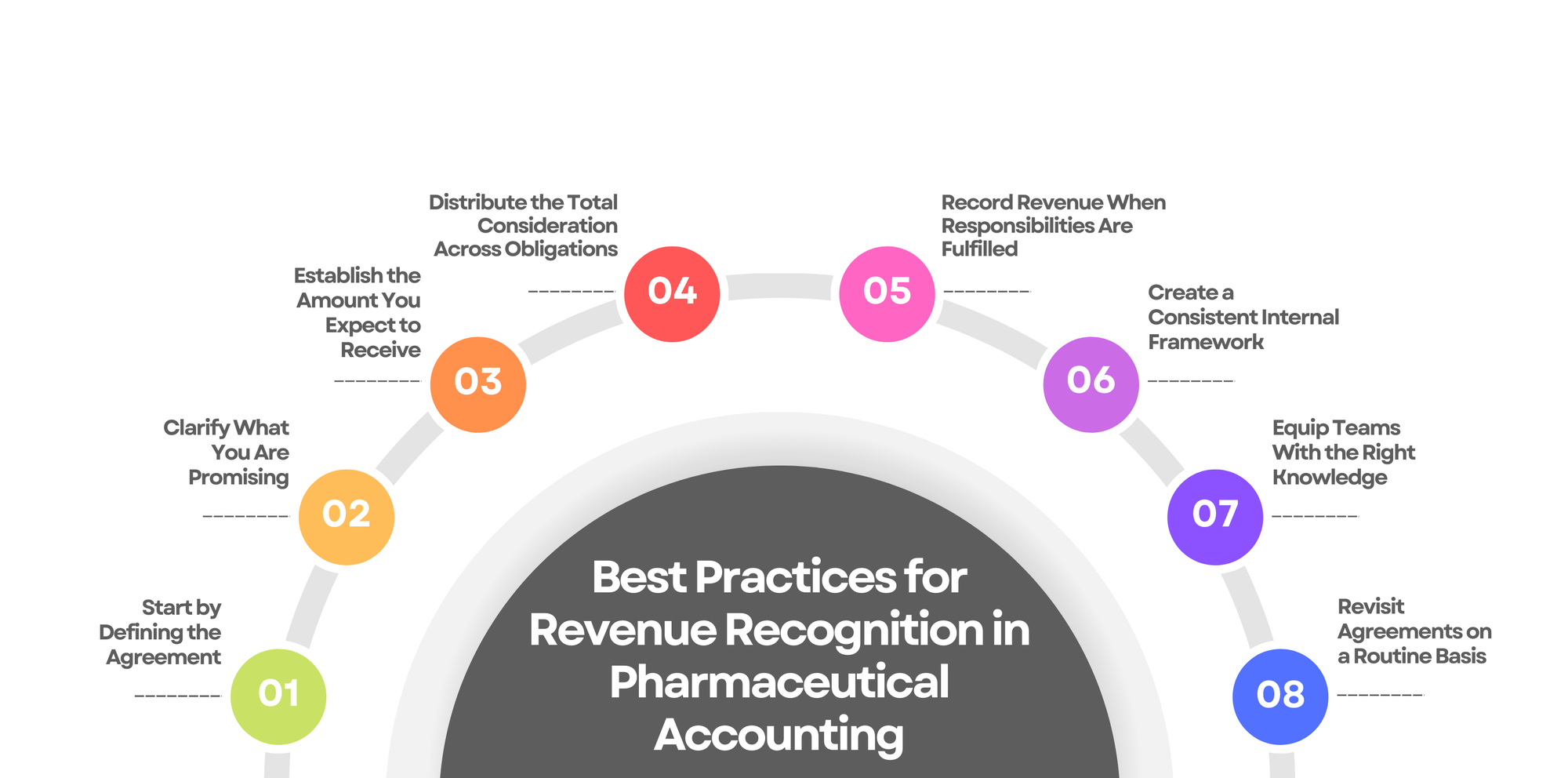
Following consistent practices not only supports compliance but also ensures that financial statements reflect the true performance of the business. Below are key best practices to guide revenue recognition in pharmaceutical accounting.
Table of Contents:
- Start by Defining the Agreement
- Clarify What You Are Promising
- Establish the Amount You Expect to Receive
- Distribute the Total Consideration Across Obligations
- Record Revenue When Responsibilities Are Fulfilled
- Create a Consistent Internal Framework
- Equip Teams With the Right Knowledge
- Revisit Agreements on a Routine Basis
Jump to a section that interests you, or keep reading.
Start by Defining the Agreement
The first step is to locate and define every customer contract. This means gathering all agreements, documenting terms, and understanding any modifications. Pharmaceutical contracts vary widely—licensing arrangements, manufacturing supply deals, and development partnerships all require careful review. A clear contract foundation ensures that later steps in the revenue recognition process are accurate.
Clarify What You Are Promising
Performance obligations are the distinct goods or services promised in a contract. In the pharmaceutical sector, these may include:
- Licensing rights
- Drug manufacturing
- Research and development services
- Milestone-based commitments
Each obligation must be clearly defined so revenue can be assigned to it correctly. This clarity prevents confusion in later stages and supports accurate timing of revenue.
Establish the Amount You Expect to Receive
The transaction price represents the total consideration expected under the contract. In pharmaceuticals, this often involves variable components, such as:
- Royalties
- Milestone payments
- Rebates
Estimating these items requires thoughtful analysis and regular updates. Because these figures change as new information becomes available, ongoing assessment is essential.
Distribute the Total Consideration Across Obligations
Once the total expected consideration is established, it must be allocated across the identified performance obligations. Allocation is based on the amount each obligation would receive if it were sold separately.
For pharmaceutical companies, this may involve assigning values to:
- Early-stage development work
- Licensing rights
- Manufacturing services
- Ongoing support activities
Accurate allocation ensures that revenue reflects the transfer of value to the customer over the life of the contract.
Record Revenue When Responsibilities Are Fulfilled
Revenue is recorded when the company satisfies a performance obligation. This can occur:
- At a point in time, such as delivering a manufactured drug
- Over time, such as providing research services
The key factor is when control of the good or service passes to the customer. Proper timing ensures that the financial statements represent the true economic results of the company’s work.
Create a Consistent Internal Framework
Strong revenue recognition policies aligned with ASC 606 provide consistency across all contracts. These policies should be:
- Documented
- Updated as regulations or business practices change
- Applied consistently across departments
This structure reduces errors and maintains uniform reporting.
Equip Teams With the Right Knowledge
Because pharmaceutical contracts can be intricate, employees involved in revenue processes must understand ASC 606 and the company’s internal policies. Training ensures:
- Accurate interpretation of contract terms
- Correct application of the standard
- Reduced risk of misstatements
Knowledgeable staff play a key role in maintaining high-quality financial reporting.
Revisit Agreements on a Routine Basis
I Contracts should be reviewed on an ongoing basis to confirm that revenue recognition reflects current terms. This is important because the pharmaceutical landscape often shifts due to:- Regulatory updates
- Amendments to agreements
- New partnership structures
Regular review helps companies stay aligned with ASC 606 and adapt to changes quickly.
Conclusion
Revenue recognition in the pharmaceutical industry demands close attention to contract structure, performance obligations, and variable consideration. By following best practices—identifying contracts correctly, defining obligations clearly, allocating prices with care, and maintaining disciplined internal processes—companies can meet ASC 606 requirements and present reliable financial information.