Benefits of Foodservice Rebates for Manufacturers and Distributors

Rebates in foodservice are often treated as something that gets settled later—after the sale, after the quarter, sometimes even after the financials are closed. That delay changes how businesses see them. Instead of being part of revenue, rebates become adjustments.
But when rebate programs are structured and tracked properly, they stop being an afterthought. They start influencing how revenue is understood, how partnerships are managed, and how pricing decisions are made.
Here’s what that looks like in practice.
Table of Contents:
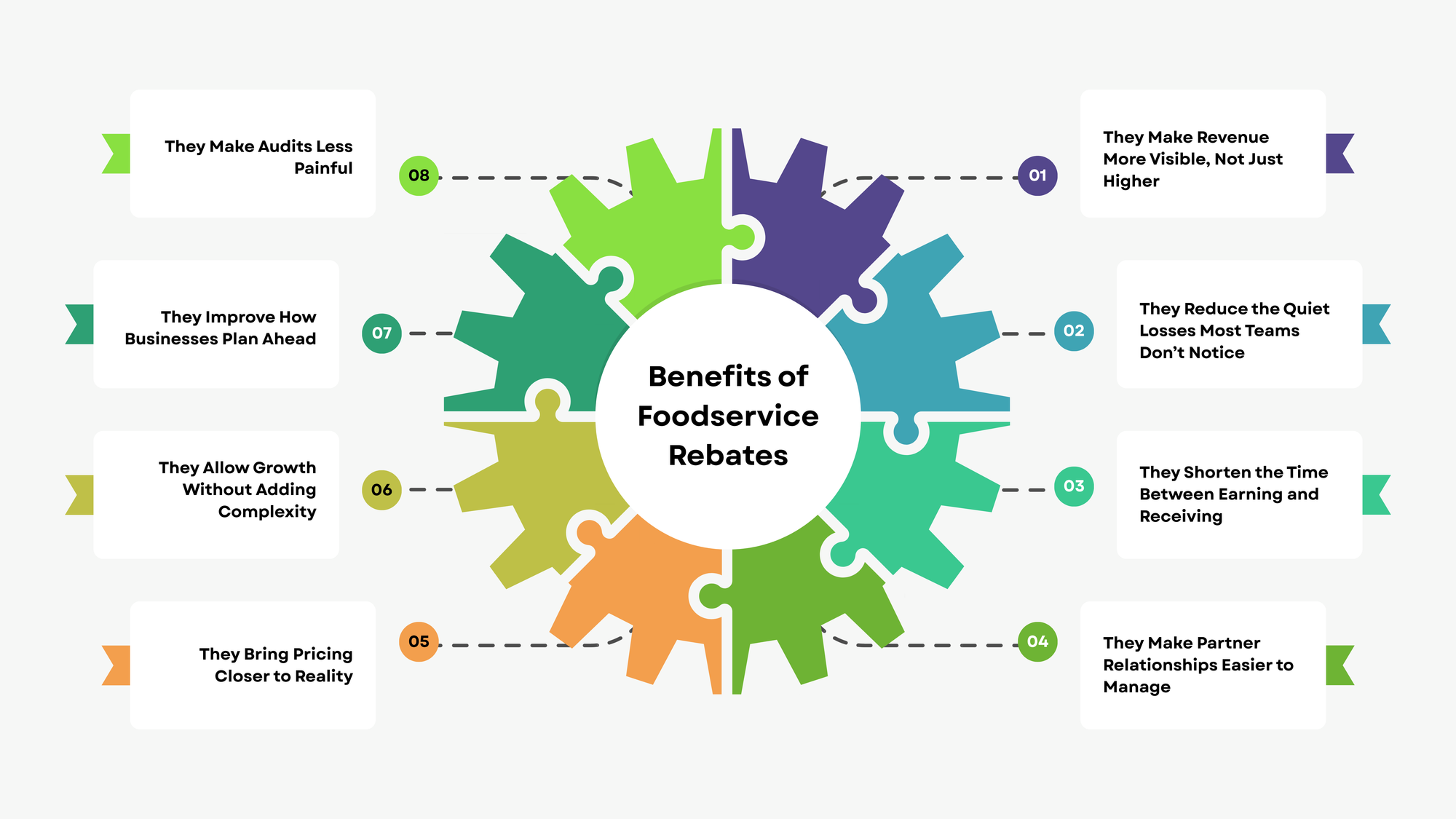
- They Make Revenue More Visible, Not Just Higher
- They Reduce the Quiet Losses Most Teams Don’t Notice
- They Shorten the Time Between Earning and Receiving
- They Make Partner Relationships Easier to Manage
- They Bring Pricing Closer to Reality
- They Allow Growth Without Adding Complexity
- They Improve How Businesses Plan Ahead
- They Make Audits Less Painful
Jump to a section that interests you, or keep reading.
They Make Revenue More Visible, Not Just Higher
In many foodservice businesses, rebate earnings are not fully visible during the selling period. Teams know agreements exist, but they don’t always know how much has been earned so far, whether targets are being met, or if certain tiers are within reach.
This creates a gap between what is expected and what is actually realized.
When rebate data is tracked consistently against real transactions, that gap starts to close. You can see how much has been earned at any point in time, which customers or distributors are contributing to those earnings, and whether you are close to hitting higher rebate tiers.
This doesn’t just improve reporting. It changes behavior. Sales and finance teams can make decisions during the period, not after it ends.
They Reduce the Quiet Losses Most Teams Don’t Notice
Revenue leakage in foodservice rarely comes from one big mistake. It usually comes from small gaps—missed claims, incorrect calculations, or agreements that aren’t followed exactly.
These issues often go unnoticed because rebate processes are spread across spreadsheets, emails, and different teams. By the time discrepancies are found, it’s too late to recover the full amount.
When rebate agreements are applied directly to transactional data, those gaps become easier to spot. If volumes don’t match expectations or if a claim doesn’t align with the agreement, it shows up early.
This doesn’t eliminate errors completely, but it makes them visible when they can still be corrected.
They Shorten the Time Between Earning and Receiving
Foodservice rebate cycles can be slow. Data needs to be collected from multiple parties, validated, and then reconciled. Each step introduces delays, especially when formats and timelines differ between manufacturers, distributors, and operators.
The longer this cycle takes, the harder it becomes to maintain accuracy and trust.
When rebate calculations are tied closely to actual sales data, claims can be generated and validated faster. There is less back-and-forth, fewer disputes, and a clearer understanding of how each number was derived.
The result is simple: the time between earning a rebate and receiving it becomes shorter and more predictable.
They Make Partner Relationships Easier to Manage
Rebates are not just financial agreements. They are also a way to guide behavior across the supply chain. Manufacturers use them to encourage volume, distributors use them to align with suppliers, and operators rely on them to manage costs.
But when the numbers behind these agreements are unclear, conversations quickly turn into disputes.
When all parties are working from the same data and the same logic, those conversations change. Instead of debating what happened, teams can focus on what to do next—whether that means adjusting targets, revisiting terms, or planning future promotions.
Clarity doesn’t remove negotiation, but it removes unnecessary friction.
They Bring Pricing Closer to Reality
In foodservice, the listed price is rarely the final price. Rebates, discounts, and incentives all adjust what a business actually earns.
If rebates are not accounted for properly, pricing decisions are based on incomplete information. A deal might look profitable on the surface but tell a different story once rebates are applied.
When rebate data is integrated into how pricing is reviewed, the picture becomes clearer. Teams can see net revenue instead of just gross revenue. They can understand which deals are truly working and which ones are not.
This leads to more grounded decisions—not just about pricing, but also about which customers, products, or agreements to prioritize.
They Allow Growth Without Adding Complexity
As a foodservice business expands, rebate structures tend to become more complex. There are more customers, more products, and more customized agreements.
If the process behind rebates stays manual, that complexity grows faster than the business can handle. Teams spend more time managing data than understanding it.
When rebate processes are standardized and automated, complexity is still there—but it becomes manageable. Agreements can be applied consistently across large volumes of data, and new deals can be added without rebuilding the entire process each time.
This allows businesses to grow without turning rebate management into a bottleneck.
They Improve How Businesses Plan Ahead
Rebates are often left out of forward planning because the data is unreliable or delayed. Finance teams may adjust for them later, but they are not always built into forecasts from the start.
This limits how accurate those forecasts can be.
When rebate earnings are tracked in real time and tied to actual performance, they can be included in planning models. Teams can estimate future earnings based on current trends, test different scenarios, and understand how changes in volume or pricing will affect outcomes.
Planning becomes less about assumptions and more about what is already happening in the business.
They Make Audits Less Painful
Rebates come with financial and contractual obligations. During audits, businesses need to show how amounts were calculated, which agreements applied, and whether everything was recorded correctly.When data is scattered, this becomes difficult. Supporting documents are hard to find, and calculations are not always easy to trace.
When rebate processes are structured, there is a clear record of each step—from agreement terms to final payouts. This doesn’t just help during audits. It reduces the effort required to prepare for them in the first place.
Closing Thought
Foodservice rebates don’t change the business on their own. What changes things is how clearly they are tracked, understood, and used in decision-making.
When rebates move from being delayed adjustments to being part of day-to-day visibility, they start influencing more than just finance. They shape how teams sell, how partners work together, and how confident a business can be in its numbers.